Python eBooks
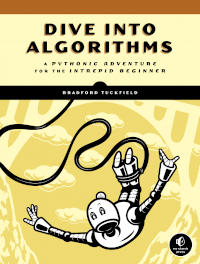
Dive Into Algorithms
Dive Into Algorithms is a wide-ranging, Pythonic tour of many of the world's most interesting algorithms. With little more than a bit of computer programming experience and basic high-school math, you'll explore standard computer science algorithms for searching, sorting, and optimization; human-based algorithms that help us determine how to catch a baseball or eat the right amount at a buffet; and advanced algorithms like ones used in machine learning and artificial intelligence. You'll even explore how ancient Egyptians and Russian peasants used algorithms to multiply numbers, how the ancient Greeks used them to find greatest common divisors, and how Japanese scholars in the age of samurai designed algorithms capable of generating magic squares. You'll explore algorithms that are useful in pure mathematics and learn how mathematical ideas can improve algorithms. You'll learn about an algorithm for generating continued fractions, one for quick calculations of square roots, and anot ...
Dive Into Algorithms is a wide-ranging, Pythonic tour of many of the world's most interesting algorithms. With little more than a bit of computer programming experience and basic high-school math, you'll explore standard computer science algorithms for searching, sorting, and optimization; human-based algorithms that help us determine how to catch a baseball or eat the right amount at a buffet; and advanced algorithms like ones used in machine learning and artificial intelligence. You'll even explore how ancient Egyptians and Russian peasants used algorithms to multiply numbers, how the ancient Greeks used them to find greatest common divisors, and how Japanese scholars in the age of samurai designed algorithms capable of generating magic squares. You'll explore algorithms that are useful in pure mathematics and learn how mathematical ideas can improve algorithms. You'll learn about an algorithm for generating continued fractions, one for quick calculations of square roots, and anot ...
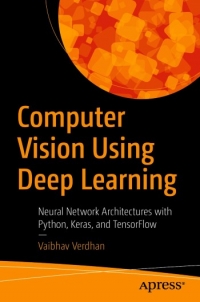
Computer Vision Using Deep Learning
Organizations spend huge resources in developing software that can perform the way a human does. Image classification, object detection and tracking, pose estimation, facial recognition, and sentiment estimation all play a major role in solving computer vision problems. This book will bring into focus these and other deep learning architectures and techniques to help you create solutions using Keras and the TensorFlow library. You'll also review mutliple neural network architectures, including LeNet, AlexNet, VGG, Inception, R-CNN, Fast R-CNN, Faster R-CNN, Mask R-CNN, YOLO, and SqueezeNet and see how they work alongside Python code via best practices, tips, tricks, shortcuts, and pitfalls. All code snippets will be broken down and discussed thoroughly so you can implement the same principles in your respective environments. Computer Vision Using Deep Learning offers a comprehensive yet succinct guide that stitches DL and CV together to automate operations, reduce human i ...
Organizations spend huge resources in developing software that can perform the way a human does. Image classification, object detection and tracking, pose estimation, facial recognition, and sentiment estimation all play a major role in solving computer vision problems. This book will bring into focus these and other deep learning architectures and techniques to help you create solutions using Keras and the TensorFlow library. You'll also review mutliple neural network architectures, including LeNet, AlexNet, VGG, Inception, R-CNN, Fast R-CNN, Faster R-CNN, Mask R-CNN, YOLO, and SqueezeNet and see how they work alongside Python code via best practices, tips, tricks, shortcuts, and pitfalls. All code snippets will be broken down and discussed thoroughly so you can implement the same principles in your respective environments. Computer Vision Using Deep Learning offers a comprehensive yet succinct guide that stitches DL and CV together to automate operations, reduce human i ...
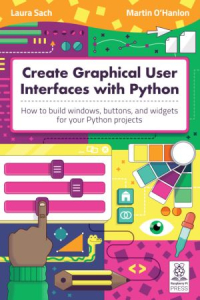
Create Graphical User Interfaces with Python
Add buttons, boxes, pictures and colours and more to your Python programs using the guizero library, which is quick, accessible, and understandable for all. This 156-page book is suitable for everyone, from beginners to experienced Python programmers who want to explore graphical user interfaces (GUIs). There are ten fun projects for you to create, including a painting program, an emoji match game, and a stop-motion animation creator. - Create games and fun Python programs; - Learn how to create your own graphical user interfaces; - Use windows, text boxes, buttons, images, and more; - Learn about event-based programming; - Explore good (and bad) user interface design. ...
Add buttons, boxes, pictures and colours and more to your Python programs using the guizero library, which is quick, accessible, and understandable for all. This 156-page book is suitable for everyone, from beginners to experienced Python programmers who want to explore graphical user interfaces (GUIs). There are ten fun projects for you to create, including a painting program, an emoji match game, and a stop-motion animation creator. - Create games and fun Python programs; - Learn how to create your own graphical user interfaces; - Use windows, text boxes, buttons, images, and more; - Learn about event-based programming; - Explore good (and bad) user interface design. ...
Introduction to Scientific Programming with Python
This open book offers an initial introduction to programming for scientific and computational applications using the Python programming language. The presentation style is compact and example-based, making it suitable for students and researchers with little or no prior experience in programming. The book uses relevant examples from mathematics and the natural sciences to present programming as a practical toolbox that can quickly enable readers to write their own programs for data processing and mathematical modeling. These tools include file reading, plotting, simple text analysis, and using NumPy for numerical computations, which are fundamental building blocks of all programs in data science and computational science. At the same time, readers are introduced to the fundamental concepts of programming, including variables, functions, loops, classes, and object-oriented programming. Accordingly, the book provides a sound basis for further computer science and programming s ...
This open book offers an initial introduction to programming for scientific and computational applications using the Python programming language. The presentation style is compact and example-based, making it suitable for students and researchers with little or no prior experience in programming. The book uses relevant examples from mathematics and the natural sciences to present programming as a practical toolbox that can quickly enable readers to write their own programs for data processing and mathematical modeling. These tools include file reading, plotting, simple text analysis, and using NumPy for numerical computations, which are fundamental building blocks of all programs in data science and computational science. At the same time, readers are introduced to the fundamental concepts of programming, including variables, functions, loops, classes, and object-oriented programming. Accordingly, the book provides a sound basis for further computer science and programming s ...
First Semester in Numerical Analysis with Python
The book is based on "First semester in Numerical Analysis with Julia". The contents of the original book are retained, while all the algorithms are implemented in Python (Version 3.8.0). Python is an open source (under OSI), interpreted, general-purpose programming language that has a large number of users around the world. Python is ranked the third in August 2020 by the TIOBE programming community index 2 , a measure of popularity of programming languages, and is the top-ranked interpreted language. We hope this book will better serve readers who are interested in a first course in Numerical Analysis, but are more familiar with Python for the implementation of the algorithms. The first chapter of the book has a self-contained tutorial for Python including how to set up the computer environment. Anaconda, the open-source individual edition, is recommended for an easy installation of Python and effortless management of Python package ...
The book is based on "First semester in Numerical Analysis with Julia". The contents of the original book are retained, while all the algorithms are implemented in Python (Version 3.8.0). Python is an open source (under OSI), interpreted, general-purpose programming language that has a large number of users around the world. Python is ranked the third in August 2020 by the TIOBE programming community index 2 , a measure of popularity of programming languages, and is the top-ranked interpreted language. We hope this book will better serve readers who are interested in a first course in Numerical Analysis, but are more familiar with Python for the implementation of the algorithms. The first chapter of the book has a self-contained tutorial for Python including how to set up the computer environment. Anaconda, the open-source individual edition, is recommended for an easy installation of Python and effortless management of Python package ...
First Semester in Numerical Analysis with Python
The book is based on "First semester in Numerical Analysis with Julia". The contents of the original book are retained, while all the algorithms are implemented in Python (Version 3.8.0). Python is an open source (under OSI), interpreted, general-purpose programming language that has a large number of users around the world. Python is ranked the third in August 2020 by the TIOBE programming community index 2 , a measure of popularity of programming languages, and is the top-ranked interpreted language. We hope this book will better serve readers who are interested in a first course in Numerical Analysis, but are more familiar with Python for the implementation of the algorithms. The first chapter of the book has a self-contained tutorial for Python including how to set up the computer environment. Anaconda, the open-source individual edition, is recommended for an easy installation of Python and effortless management of Python package ...
The book is based on "First semester in Numerical Analysis with Julia". The contents of the original book are retained, while all the algorithms are implemented in Python (Version 3.8.0). Python is an open source (under OSI), interpreted, general-purpose programming language that has a large number of users around the world. Python is ranked the third in August 2020 by the TIOBE programming community index 2 , a measure of popularity of programming languages, and is the top-ranked interpreted language. We hope this book will better serve readers who are interested in a first course in Numerical Analysis, but are more familiar with Python for the implementation of the algorithms. The first chapter of the book has a self-contained tutorial for Python including how to set up the computer environment. Anaconda, the open-source individual edition, is recommended for an easy installation of Python and effortless management of Python package ...
Beyond the Basic Stuff with Python
You've completed a basic Python programming tutorial or finished Al Sweigart's best selling Automate the Boring Stuff with Python. What's the next step toward becoming a capable, confident software developer? Welcome to Beyond the Basic Stuff with Python. More than a mere collection of advanced syntax and masterful tips for writing clean code, you'll learn how to advance your Python programming skills by using the command line and other professional tools like code formatters, type checkers, linters, and version control. Sweigart takes you through best practices for setting up your development environment, naming variables, and improving readability, then tackles documentation, organization and performance measurement, as well as object-oriented design and the Big-O algorithm analysis commonly used in coding interviews. The skills you learn will boost your ability to program - not just in Python but in any language. You'll learn: - Coding style, and how to u ...
You've completed a basic Python programming tutorial or finished Al Sweigart's best selling Automate the Boring Stuff with Python. What's the next step toward becoming a capable, confident software developer? Welcome to Beyond the Basic Stuff with Python. More than a mere collection of advanced syntax and masterful tips for writing clean code, you'll learn how to advance your Python programming skills by using the command line and other professional tools like code formatters, type checkers, linters, and version control. Sweigart takes you through best practices for setting up your development environment, naming variables, and improving readability, then tackles documentation, organization and performance measurement, as well as object-oriented design and the Big-O algorithm analysis commonly used in coding interviews. The skills you learn will boost your ability to program - not just in Python but in any language. You'll learn: - Coding style, and how to u ...
Machine Learning for Algorithmic Trading, 2nd Edition
The explosive growth of digital data has boosted the demand for expertise in trading strategies that use machine learning (ML). This thoroughly revised and expanded 2nd edition enables you to build and evaluate sophisticated supervised, unsupervised, and reinforcement learning models. This edition introduces end-to-end machine learning for the trading workflow, from the idea and feature engineering to model optimization, strategy design, and backtesting. It illustrates this workflow using examples that range from linear models and tree-based ensembles to deep-learning techniques from the cutting edge of the research frontier. This revised version shows how to work with market, fundamental, and alternative data, such as tick data, minute and daily bars, SEC filings, earnings call transcripts, financial news, or satellite images to generate tradeable signals. It illustrates how to engineer financial features or alpha factors that enable a machine learning model to predict returns f ...
The explosive growth of digital data has boosted the demand for expertise in trading strategies that use machine learning (ML). This thoroughly revised and expanded 2nd edition enables you to build and evaluate sophisticated supervised, unsupervised, and reinforcement learning models. This edition introduces end-to-end machine learning for the trading workflow, from the idea and feature engineering to model optimization, strategy design, and backtesting. It illustrates this workflow using examples that range from linear models and tree-based ensembles to deep-learning techniques from the cutting edge of the research frontier. This revised version shows how to work with market, fundamental, and alternative data, such as tick data, minute and daily bars, SEC filings, earnings call transcripts, financial news, or satellite images to generate tradeable signals. It illustrates how to engineer financial features or alpha factors that enable a machine learning model to predict returns f ...
Python Machine Learning By Example, 3rd Edition
Python Machine Learning By Example, 3rd Edition serves as a comprehensive gateway into the world of machine learning (ML). With six new chapters, on topics including movie recommendation engine development with Naïve Bayes, recognizing faces with support vector machine, predicting stock prices with artificial neural networks, categorizing images of clothing with convolutional neural networks, predicting with sequences using recurring neural networks, and leveraging reinforcement learning for making decisions, the book has been considerably updated for the latest enterprise requirements. At the same time, this book provides actionable insights on the key fundamentals of ML with Python programming. Hayden applies his expertise to demonstrate implementations of algorithms in Python both from scratch and with libraries. Each chapter walks through an industry-adopted application. With the help of realistic examples, you will gain an understanding of the mechan ...
Python Machine Learning By Example, 3rd Edition serves as a comprehensive gateway into the world of machine learning (ML). With six new chapters, on topics including movie recommendation engine development with Naïve Bayes, recognizing faces with support vector machine, predicting stock prices with artificial neural networks, categorizing images of clothing with convolutional neural networks, predicting with sequences using recurring neural networks, and leveraging reinforcement learning for making decisions, the book has been considerably updated for the latest enterprise requirements. At the same time, this book provides actionable insights on the key fundamentals of ML with Python programming. Hayden applies his expertise to demonstrate implementations of algorithms in Python both from scratch and with libraries. Each chapter walks through an industry-adopted application. With the help of realistic examples, you will gain an understanding of the mechan ...
Advanced Analytics in Power BI with R and Python
This easy-to-follow guide provides R and Python recipes to help you learn and apply the top languages in the field of data analytics to your work in Microsoft Power BI. Data analytics expert and author Ryan Wade shows you how to use R and Python to perform tasks that are extremely hard, if not impossible, to do using native Power BI tools. For example, you will learn to score Power BI data using custom data science models and powerful models from Microsoft Cognitive Services. The R and Python languages are powerful complements to Power BI. They enable advanced data transformation techniques that are difficult to perform in Power BI in its default configuration but become easier by leveraging the capabilities of R and Python. If you are a business analyst, data analyst, or a data scientist who wants to push Power BI and transform it from being just a business intelligence tool into an advanced data analytics tool, then this is the book to help you do that. ...
This easy-to-follow guide provides R and Python recipes to help you learn and apply the top languages in the field of data analytics to your work in Microsoft Power BI. Data analytics expert and author Ryan Wade shows you how to use R and Python to perform tasks that are extremely hard, if not impossible, to do using native Power BI tools. For example, you will learn to score Power BI data using custom data science models and powerful models from Microsoft Cognitive Services. The R and Python languages are powerful complements to Power BI. They enable advanced data transformation techniques that are difficult to perform in Power BI in its default configuration but become easier by leveraging the capabilities of R and Python. If you are a business analyst, data analyst, or a data scientist who wants to push Power BI and transform it from being just a business intelligence tool into an advanced data analytics tool, then this is the book to help you do that. ...
Building Versatile Mobile Apps with Python and REST
Develop versatile iOS apps using Python with RESTful web services. This book will show you how to blend Django, a high-level Python Web framework, with Django REST, the powerful, feature-filled extension, to build iOS mobile apps. Using easy-to-follow examples, you'll begin by building a simple app using the RESTful Web API and iOS. You'll begin by using traditional Django to create models and connect your App to the database. You'll then see how to serialize your data and create the RESTful API. The second part of the book introduces Xcode, a programming environment to develop iOS apps. Using Swift, the programming language for iOS, you'll design the actual app. Once you have your back-end in Django and a front-end in Swift, you'll connect them using our RESTful API. You'll be able to log in, browse places of interest, and rate them and leave comments. Guided step-by-step instructions, Building Versatile Mobile Apps with Python and REST will demonstrate how ...
Develop versatile iOS apps using Python with RESTful web services. This book will show you how to blend Django, a high-level Python Web framework, with Django REST, the powerful, feature-filled extension, to build iOS mobile apps. Using easy-to-follow examples, you'll begin by building a simple app using the RESTful Web API and iOS. You'll begin by using traditional Django to create models and connect your App to the database. You'll then see how to serialize your data and create the RESTful API. The second part of the book introduces Xcode, a programming environment to develop iOS apps. Using Swift, the programming language for iOS, you'll design the actual app. Once you have your back-end in Django and a front-end in Swift, you'll connect them using our RESTful API. You'll be able to log in, browse places of interest, and rate them and leave comments. Guided step-by-step instructions, Building Versatile Mobile Apps with Python and REST will demonstrate how ...