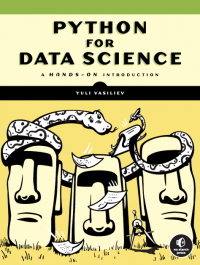
Python for Data Science
Python is an ideal choice for accessing, manipulating, and gaining insights from data of all kinds. Python for Data Science introduces you to the Pythonic world of data analysis with a learn-by-doing approach rooted in practical examples and hands-on activities. You'll learn how to write Python code to obtain, transform, and analyze data, practicing state-of-the-art data processing techniques for use cases in business management, marketing, and decision support. You will discover Python's rich set of built-in data structures for basic operations, as well as its robust ecosystem of open-source libraries for data science, including NumPy, pandas, scikit-learn, matplotlib, and more. Examples show how to load data in various formats, how to streamline, group, and aggregate data sets, and how to create charts, maps, and other visualizations. Later chapters go in-depth with demonstrations of real-world data applications, including using location data to power a taxi service, market basket ...
Python is an ideal choice for accessing, manipulating, and gaining insights from data of all kinds. Python for Data Science introduces you to the Pythonic world of data analysis with a learn-by-doing approach rooted in practical examples and hands-on activities. You'll learn how to write Python code to obtain, transform, and analyze data, practicing state-of-the-art data processing techniques for use cases in business management, marketing, and decision support. You will discover Python's rich set of built-in data structures for basic operations, as well as its robust ecosystem of open-source libraries for data science, including NumPy, pandas, scikit-learn, matplotlib, and more. Examples show how to load data in various formats, how to streamline, group, and aggregate data sets, and how to create charts, maps, and other visualizations. Later chapters go in-depth with demonstrations of real-world data applications, including using location data to power a taxi service, market basket ...
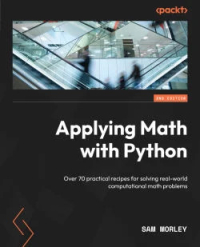
Applying Math with Python, 2nd Edition
The updated edition of Applying Math with Python will help you solve complex problems in a wide variety of mathematical fields in simple and efficient ways. Old recipes have been revised for new libraries and several recipes have been added to demonstrate new tools such as JAX. You'll start by refreshing your knowledge of several core mathematical fields and learn about packages covered in Python's scientific stack, including NumPy, SciPy, and Matplotlib. As you progress, you'll gradually get to grips with more advanced topics of calculus, probability, and networks (graph theory). Once you've developed a solid base in these topics, you'll have the confidence to set out on math adventures with Python as you explore Python's applications in data science and statistics, forecasting, geometry, and optimization. The final chapters will take you through a collection of miscellaneous problems, including working with specific data formats and accelerating code. By the end of this book, y ...
The updated edition of Applying Math with Python will help you solve complex problems in a wide variety of mathematical fields in simple and efficient ways. Old recipes have been revised for new libraries and several recipes have been added to demonstrate new tools such as JAX. You'll start by refreshing your knowledge of several core mathematical fields and learn about packages covered in Python's scientific stack, including NumPy, SciPy, and Matplotlib. As you progress, you'll gradually get to grips with more advanced topics of calculus, probability, and networks (graph theory). Once you've developed a solid base in these topics, you'll have the confidence to set out on math adventures with Python as you explore Python's applications in data science and statistics, forecasting, geometry, and optimization. The final chapters will take you through a collection of miscellaneous problems, including working with specific data formats and accelerating code. By the end of this book, y ...
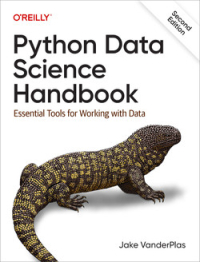
Python Data Science Handbook, 2nd Edition
Python is a first-class tool for many researchers, primarily because of its libraries for storing, manipulating, and gaining insight from data. Several resources exist for individual pieces of this data science stack, but only with the new edition of Python Data Science Handbook do you get them all - IPython, NumPy, pandas, Matplotlib, scikit-learn, and other related tools. Working scientists and data crunchers familiar with reading and writing Python code will find the second edition of this comprehensive desk reference ideal for tackling day-to-day issues: manipulating, transforming, and cleaning data; visualizing different types of data; and using data to build statistical or machine learning models. Quite simply, this is the must-have reference for scientific computing in Python. ...
Python is a first-class tool for many researchers, primarily because of its libraries for storing, manipulating, and gaining insight from data. Several resources exist for individual pieces of this data science stack, but only with the new edition of Python Data Science Handbook do you get them all - IPython, NumPy, pandas, Matplotlib, scikit-learn, and other related tools. Working scientists and data crunchers familiar with reading and writing Python code will find the second edition of this comprehensive desk reference ideal for tackling day-to-day issues: manipulating, transforming, and cleaning data; visualizing different types of data; and using data to build statistical or machine learning models. Quite simply, this is the must-have reference for scientific computing in Python. ...