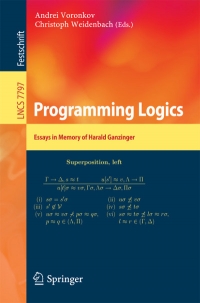
Programming Logics
This Festschrift volume, published in memory of Harald Ganzinger, contains 17 papers from colleagues all over the world and covers all the fields to which Harald Ganzinger dedicated his work during his academic career. The volume begins with a complete account of Harald Ganzinger's work and then turns its focus to the research of his former colleagues, students, and friends who pay tribute to him through their writing. Their individual papers span a broad range of topics, including programming language semantics, analysis and verification, first-order and higher-order theorem proving, unification theory, non-classical logics, reasoning modulo theories, and applications of automated reasoning in biology. ...
This Festschrift volume, published in memory of Harald Ganzinger, contains 17 papers from colleagues all over the world and covers all the fields to which Harald Ganzinger dedicated his work during his academic career. The volume begins with a complete account of Harald Ganzinger's work and then turns its focus to the research of his former colleagues, students, and friends who pay tribute to him through their writing. Their individual papers span a broad range of topics, including programming language semantics, analysis and verification, first-order and higher-order theorem proving, unification theory, non-classical logics, reasoning modulo theories, and applications of automated reasoning in biology. ...
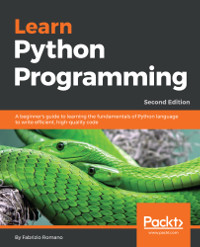
Learn Python Programming, 2nd Edition
Learn Python Programming creates a foundation for those who are interested in developing their skills in Python programming. The book starts with the fundamentals of programming with Python and ends by exploring different topics such as GUIs and real-world apps. You will begin by exploring the foundations of and fundamental topics on Python and learn to manipulate them. Then, you'll explore different programming paradigms that will allow you to find the best approach to a situation, and you'll also understand how to carry out performance optimization as well as effective debugging. As you make your way through the chapters, you'll control the flow of a program, and persist and utilize an interchange format to exchange data. You'll also walk through cryptographic services in Python and understand secure tokens. Throughout, the book covers various types of applications, and it concludes with building real-world applications based on all the concepts that you learned. By the end ...
Learn Python Programming creates a foundation for those who are interested in developing their skills in Python programming. The book starts with the fundamentals of programming with Python and ends by exploring different topics such as GUIs and real-world apps. You will begin by exploring the foundations of and fundamental topics on Python and learn to manipulate them. Then, you'll explore different programming paradigms that will allow you to find the best approach to a situation, and you'll also understand how to carry out performance optimization as well as effective debugging. As you make your way through the chapters, you'll control the flow of a program, and persist and utilize an interchange format to exchange data. You'll also walk through cryptographic services in Python and understand secure tokens. Throughout, the book covers various types of applications, and it concludes with building real-world applications based on all the concepts that you learned. By the end ...
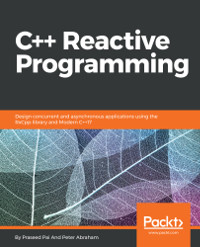
C++ Reactive Programming
Reactive programming is an effective way to build highly responsive applications with an easy-to-maintain code base. This book covers the essential functional reactive concepts that will help you build highly concurrent, event-driven, and asynchronous applications in a simpler and less error-prone way. C++ Reactive Programming begins with a discussion on how event processing was undertaken by different programming systems earlier. After a brisk introduction to modern C++ (C++17), you'll be taken through language-level concurrency and the lock-free programming model to set the stage for our foray into the Functional Programming model. Following this, you'll be introduced to RxCpp and its programming model. You'll be able to gain deep insights into the RxCpp library, which facilitates reactive programming. You'll learn how to deal with reactive programming using Qt/C++ (for the desktop) and C++ microservices for the Web. By the end of the book, you will be well versed with advanced ...
Reactive programming is an effective way to build highly responsive applications with an easy-to-maintain code base. This book covers the essential functional reactive concepts that will help you build highly concurrent, event-driven, and asynchronous applications in a simpler and less error-prone way. C++ Reactive Programming begins with a discussion on how event processing was undertaken by different programming systems earlier. After a brisk introduction to modern C++ (C++17), you'll be taken through language-level concurrency and the lock-free programming model to set the stage for our foray into the Functional Programming model. Following this, you'll be introduced to RxCpp and its programming model. You'll be able to gain deep insights into the RxCpp library, which facilitates reactive programming. You'll learn how to deal with reactive programming using Qt/C++ (for the desktop) and C++ microservices for the Web. By the end of the book, you will be well versed with advanced ...
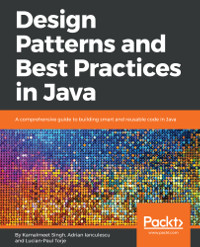
Design Patterns and Best Practices in Java
Having a knowledge of design patterns enables you, as a developer, to improve your code base, promote code reuse, and make the architecture more robust. As languages evolve, new features take time to fully understand before they are adopted en masse. The mission of this book is to ease the adoption of the latest trends and provide good practices for programmers. We focus on showing you the practical aspects of smarter coding in Java. We'll start off by going over object-oriented (OOP) and functional programming (FP) paradigms, moving on to describe the most frequently used design patterns in their classical format and explain how Java's functional programming features are changing them. You will learn to enhance implementations by mixing OOP and FP, and finally get to know about the reactive programming model, where FP and OOP are used in conjunction with a view to writing better code. Gradually, the book will show you the latest trends in architecture, moving from MVC to microse ...
Having a knowledge of design patterns enables you, as a developer, to improve your code base, promote code reuse, and make the architecture more robust. As languages evolve, new features take time to fully understand before they are adopted en masse. The mission of this book is to ease the adoption of the latest trends and provide good practices for programmers. We focus on showing you the practical aspects of smarter coding in Java. We'll start off by going over object-oriented (OOP) and functional programming (FP) paradigms, moving on to describe the most frequently used design patterns in their classical format and explain how Java's functional programming features are changing them. You will learn to enhance implementations by mixing OOP and FP, and finally get to know about the reactive programming model, where FP and OOP are used in conjunction with a view to writing better code. Gradually, the book will show you the latest trends in architecture, moving from MVC to microse ...
Hands-On Functional Programming in Rust
Functional Programming allows developers to divide programs into smaller, reusable components that ease the creation, testing, and maintenance of software as a whole. Combined with the power of Rust, you can develop robust and scalable applications that fulfill modern day software requirements. This book will help you discover all the Rust features that can be used to build software in a functional way. We begin with a brief comparison of the functional and object-oriented approach to different problems and patterns. We then quickly look at the patterns of control flow, data the abstractions of these unique to Functional Programming. The next part covers how to create functional apps in Rust; mutability and ownership, which are exclusive to Rust, are also discussed. Pure functions are examined next and you'll master closures, their various types, and currying. We also look at implementing concurrency through functional design principles and metaprogramming using macros. Finally, we ...
Functional Programming allows developers to divide programs into smaller, reusable components that ease the creation, testing, and maintenance of software as a whole. Combined with the power of Rust, you can develop robust and scalable applications that fulfill modern day software requirements. This book will help you discover all the Rust features that can be used to build software in a functional way. We begin with a brief comparison of the functional and object-oriented approach to different problems and patterns. We then quickly look at the patterns of control flow, data the abstractions of these unique to Functional Programming. The next part covers how to create functional apps in Rust; mutability and ownership, which are exclusive to Rust, are also discussed. Pure functions are examined next and you'll master closures, their various types, and currying. We also look at implementing concurrency through functional design principles and metaprogramming using macros. Finally, we ...
Programming 101
Understand the importance of programming, even if you've never programmed before! This book will teach you the basics of programming using the Processing programming language. You will create your own Processing sketches, using personal images, themes, or hobbies that you enjoy. The chapters in the book will demonstrate the process of programming, starting with formulating an idea, planning, building on past projects, and refining the work, similar to writing an essay or composing a song. This approach will guide you to make use of logic and mathematics to produce beautiful effects. The term for program in Processing is sketch, though the sketches featured in this book are far more than static drawings; they incorporate interaction, animation, video, audio, and accessing files on the local computer and on the Web. Technical features are introduced and explained in the context of complete examples: games (Snake, Hangman, jigsaw, slingshot), making a collage of family images and ...
Understand the importance of programming, even if you've never programmed before! This book will teach you the basics of programming using the Processing programming language. You will create your own Processing sketches, using personal images, themes, or hobbies that you enjoy. The chapters in the book will demonstrate the process of programming, starting with formulating an idea, planning, building on past projects, and refining the work, similar to writing an essay or composing a song. This approach will guide you to make use of logic and mathematics to produce beautiful effects. The term for program in Processing is sketch, though the sketches featured in this book are far more than static drawings; they incorporate interaction, animation, video, audio, and accessing files on the local computer and on the Web. Technical features are introduced and explained in the context of complete examples: games (Snake, Hangman, jigsaw, slingshot), making a collage of family images and ...
Pro Machine Learning Algorithms
Bridge the gap between a high-level understanding of how an algorithm works and knowing the nuts and bolts to tune your models better. This book will give you the confidence and skills when developing all the major machine learning models. In Pro Machine Learning Algorithms, you will first develop the algorithm in Excel so that you get a practical understanding of all the levers that can be tuned in a model, before implementing the models in Python/R. You will cover all the major algorithms: supervised and unsupervised learning, which include linear/logistic regression; k-means clustering; PCA; recommender system; decision tree; random forest; GBM; and neural networks. You will also be exposed to the latest in deep learning through CNNs, RNNs, and word2vec for text mining. You will be learning not only the algorithms, but also the concepts of feature engineering to maximize the performance of a model. You will see the theory along with case studies, such as sentiment classification, ...
Bridge the gap between a high-level understanding of how an algorithm works and knowing the nuts and bolts to tune your models better. This book will give you the confidence and skills when developing all the major machine learning models. In Pro Machine Learning Algorithms, you will first develop the algorithm in Excel so that you get a practical understanding of all the levers that can be tuned in a model, before implementing the models in Python/R. You will cover all the major algorithms: supervised and unsupervised learning, which include linear/logistic regression; k-means clustering; PCA; recommender system; decision tree; random forest; GBM; and neural networks. You will also be exposed to the latest in deep learning through CNNs, RNNs, and word2vec for text mining. You will be learning not only the algorithms, but also the concepts of feature engineering to maximize the performance of a model. You will see the theory along with case studies, such as sentiment classification, ...
Concurrency in .NET
Unlock the incredible performance built into your multi-processor machines. Concurrent applications run faster because they spread work across processor cores, performing several tasks at the same time. Modern tools and techniques on the .NET platform, including parallel LINQ, functional programming, asynchronous programming, and the Task Parallel Library, offer powerful alternatives to traditional thread-based concurrency. Concurrency in .NET teaches you to write code that delivers the speed you need for performance-sensitive applications. Featuring examples in both C# and F#, this book guides you through concurrent and parallel designs that emphasize functional programming in theory and practice. You'll start with the foundations of concurrency and master essential techniques and design practices to optimize code running on modern multiprocessor systems. ...
Unlock the incredible performance built into your multi-processor machines. Concurrent applications run faster because they spread work across processor cores, performing several tasks at the same time. Modern tools and techniques on the .NET platform, including parallel LINQ, functional programming, asynchronous programming, and the Task Parallel Library, offer powerful alternatives to traditional thread-based concurrency. Concurrency in .NET teaches you to write code that delivers the speed you need for performance-sensitive applications. Featuring examples in both C# and F#, this book guides you through concurrent and parallel designs that emphasize functional programming in theory and practice. You'll start with the foundations of concurrency and master essential techniques and design practices to optimize code running on modern multiprocessor systems. ...
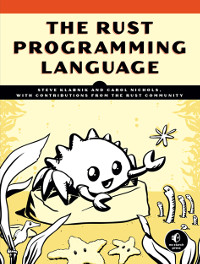
The Rust Programming Language
The Rust Programming Language is the official book on Rust, an open-source, community-developed systems programming language that runs blazingly fast, prevents segfaults, and guarantees thread safety. This is the undisputed go-to guide to Rust, written by two members of the Rust core team, with feedback and contributions from 42 members of the community. The book assumes that you've written code in another programming language but makes no assumptions about which one, meaning the material is accessible and useful to developers from a wide variety of programming backgrounds. Known by the Rust community as "The Book", The Rust Programming Language includes concept chapters, where you'll learn about a particular aspect of Rust, and project chapters, where you'll apply what you've learned so far to build small programs. The Book opens with a quick hands-on project to introduce the basics then explores key concepts in depth, such as ownership, the type system, error handling, and fear ...
The Rust Programming Language is the official book on Rust, an open-source, community-developed systems programming language that runs blazingly fast, prevents segfaults, and guarantees thread safety. This is the undisputed go-to guide to Rust, written by two members of the Rust core team, with feedback and contributions from 42 members of the community. The book assumes that you've written code in another programming language but makes no assumptions about which one, meaning the material is accessible and useful to developers from a wide variety of programming backgrounds. Known by the Rust community as "The Book", The Rust Programming Language includes concept chapters, where you'll learn about a particular aspect of Rust, and project chapters, where you'll apply what you've learned so far to build small programs. The Book opens with a quick hands-on project to introduce the basics then explores key concepts in depth, such as ownership, the type system, error handling, and fear ...
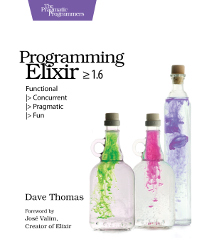
Programming Elixir 1.6
Functional programming techniques help you manage the complexities of today's real-world, concurrent systems; maximize uptime; and manage security. Enter Elixir, with its modern, Ruby-like, extendable syntax, compile and runtime evaluation, hygienic macro system, and more. But, just as importantly, Elixir brings a sense of enjoyment to parallel, functional programming. Your applications become fun to work with, and the language encourages you to experiment. Part 1 covers the basics of writing sequential Elixir programs. We'll look at the language, the tools, and the conventions. Part 2 uses these skills to start writing concurrent code—applications that use all the cores on your machine, or all the machines on your network! And we do it both with and without OTP. Part 3 looks at the more advanced features of the language, from DSLs and code generation to extending the syntax. This edition is fully updated with all the new features of Elixir 1.6, with a new chapter on structurin ...
Functional programming techniques help you manage the complexities of today's real-world, concurrent systems; maximize uptime; and manage security. Enter Elixir, with its modern, Ruby-like, extendable syntax, compile and runtime evaluation, hygienic macro system, and more. But, just as importantly, Elixir brings a sense of enjoyment to parallel, functional programming. Your applications become fun to work with, and the language encourages you to experiment. Part 1 covers the basics of writing sequential Elixir programs. We'll look at the language, the tools, and the conventions. Part 2 uses these skills to start writing concurrent code—applications that use all the cores on your machine, or all the machines on your network! And we do it both with and without OTP. Part 3 looks at the more advanced features of the language, from DSLs and code generation to extending the syntax. This edition is fully updated with all the new features of Elixir 1.6, with a new chapter on structurin ...