Trino: The Definitive Guide, 2nd Edition
Perform fast interactive analytics against different data sources using the Trino high-performance distributed SQL query engine. In the second edition of this practical guide, you'll learn how to conduct analytics on data where it lives, whether it's a data lake using Hive, a modern lakehouse with Iceberg or Delta Lake, a different system like Cassandra, Kafka, or SingleStore, or a relational database like PostgreSQL or Oracle. Analysts, software engineers, and production engineers learn how to manage, use, and even develop with Trino and make it a critical part of their data platform. Authors Matt Fuller, Manfred Moser, and Martin Traverso show you how a single Trino query can combine data from multiple sources to allow for analytics across your entire organization. ...
Perform fast interactive analytics against different data sources using the Trino high-performance distributed SQL query engine. In the second edition of this practical guide, you'll learn how to conduct analytics on data where it lives, whether it's a data lake using Hive, a modern lakehouse with Iceberg or Delta Lake, a different system like Cassandra, Kafka, or SingleStore, or a relational database like PostgreSQL or Oracle. Analysts, software engineers, and production engineers learn how to manage, use, and even develop with Trino and make it a critical part of their data platform. Authors Matt Fuller, Manfred Moser, and Martin Traverso show you how a single Trino query can combine data from multiple sources to allow for analytics across your entire organization. ...
Genomics in the Azure Cloud
This practical guide bridges the gap between general cloud computing architecture in Microsoft Azure and scientific computing for bioinformatics and genomics. You'll get a solid understanding of the architecture patterns and services that are offered in Azure and how they might be used in your bioinformatics practice. You'll get code examples that you can reuse for your specific needs. And you'll get plenty of concrete examples to illustrate how a given service is used in a bioinformatics context. You'll also get valuable advice on how to: Use enterprise platform services to easily scale your bioinformatics workloads; Organize, query, and analyze genomic data at scale; Build a genomics data lake and accompanying data warehouse; Use Azure Machine Learning to scale your model training, track model performance, and deploy winning models; Orchestrate and automate processing pipelines using Azure Data Factory and Databricks; Cloudify your organization's existing bioinformatics pipelines ...
This practical guide bridges the gap between general cloud computing architecture in Microsoft Azure and scientific computing for bioinformatics and genomics. You'll get a solid understanding of the architecture patterns and services that are offered in Azure and how they might be used in your bioinformatics practice. You'll get code examples that you can reuse for your specific needs. And you'll get plenty of concrete examples to illustrate how a given service is used in a bioinformatics context. You'll also get valuable advice on how to: Use enterprise platform services to easily scale your bioinformatics workloads; Organize, query, and analyze genomic data at scale; Build a genomics data lake and accompanying data warehouse; Use Azure Machine Learning to scale your model training, track model performance, and deploy winning models; Orchestrate and automate processing pipelines using Azure Data Factory and Databricks; Cloudify your organization's existing bioinformatics pipelines ...
Getting the Most from LINQPad Succinctly
LINQPad is a powerful testing tool for all .NET developers that can help them deliver solutions in less time. In Getting the Most from LINQPad Succinctly, returning Succinctly series author Jose Roberto Olivas Mendoza lays out different ways to extend the functionality built into LINQPad. In this ebook, you'll learn how to use LINQPad to query Entity Framework models in Visual Studio, how to work with the LINQPad command-line utility, how to write your own extensions and visualizers, and how to write custom data context drivers. ...
LINQPad is a powerful testing tool for all .NET developers that can help them deliver solutions in less time. In Getting the Most from LINQPad Succinctly, returning Succinctly series author Jose Roberto Olivas Mendoza lays out different ways to extend the functionality built into LINQPad. In this ebook, you'll learn how to use LINQPad to query Entity Framework models in Visual Studio, how to work with the LINQPad command-line utility, how to write your own extensions and visualizers, and how to write custom data context drivers. ...

The Julia Express
Julia is a high-level, dynamic programming language. Its features are well suited for numerical analysis and computational science. Julia works with other languages (C, Python, R, Rust, C++, SQL, JavaScript, ...) The Purpose of this open book is to introduce programmers to the Julia programming by example. This is a simplified exposition of the language. ...
Julia is a high-level, dynamic programming language. Its features are well suited for numerical analysis and computational science. Julia works with other languages (C, Python, R, Rust, C++, SQL, JavaScript, ...) The Purpose of this open book is to introduce programmers to the Julia programming by example. This is a simplified exposition of the language. ...
Mathematics for Game Programming and Computer Graphics
Mathematics is an essential skill when it comes to graphics and game development, particularly if you want to understand the generation of real-time computer graphics and the manipulation of objects and environments in a detailed way. Python, together with Pygame and PyOpenGL, provides you with the opportunity to explore these features under the hood, revealing how computers generate and manipulate 3D environments. Mathematics for Game Programming and Computer Graphics is an exhaustive guide to getting "back to the basics" of mathematics, using a series of problem-based, practical exercises to explore ideas around drawing graphic lines and shapes, applying vectors and vertices, constructing and rendering meshes, and working with vertex shaders. By leveraging Python, Pygame, and PyOpenGL, you'll be able to create your own mathematics-based engine and API that will be used throughout to build applications. By the end of this graphics focussed book, you'll have gained a thorough und ...
Mathematics is an essential skill when it comes to graphics and game development, particularly if you want to understand the generation of real-time computer graphics and the manipulation of objects and environments in a detailed way. Python, together with Pygame and PyOpenGL, provides you with the opportunity to explore these features under the hood, revealing how computers generate and manipulate 3D environments. Mathematics for Game Programming and Computer Graphics is an exhaustive guide to getting "back to the basics" of mathematics, using a series of problem-based, practical exercises to explore ideas around drawing graphic lines and shapes, applying vectors and vertices, constructing and rendering meshes, and working with vertex shaders. By leveraging Python, Pygame, and PyOpenGL, you'll be able to create your own mathematics-based engine and API that will be used throughout to build applications. By the end of this graphics focussed book, you'll have gained a thorough und ...
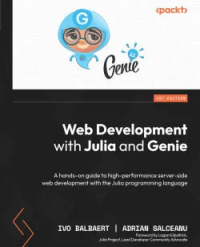
Web Development with Julia and Genie
Julia's high-performance and scalability characteristics and its extensive number of packages for visualizing data make it an excellent fit for developing web apps, web services, and web dashboards. The two parts of this book provide complete coverage to build your skills in web development. First, you'll refresh your knowledge of the main concepts in Julia that will further be used in web development. Then, you'll use Julia's standard web packages and examine how the building blocks of the web such as TCP-IP, web sockets, HTTP protocol, and so on are implemented in Julia's standard library. Each topic is discussed and developed into code that you can apply in new projects, from static websites to dashboards. You'll also understand how to choose the right Julia framework for a project. The second part of the book talks about the Genie framework. You'll learn how to build a traditional to do app following the MVC design pattern. Next, you'll add a REST API to this project, including ...
Julia's high-performance and scalability characteristics and its extensive number of packages for visualizing data make it an excellent fit for developing web apps, web services, and web dashboards. The two parts of this book provide complete coverage to build your skills in web development. First, you'll refresh your knowledge of the main concepts in Julia that will further be used in web development. Then, you'll use Julia's standard web packages and examine how the building blocks of the web such as TCP-IP, web sockets, HTTP protocol, and so on are implemented in Julia's standard library. Each topic is discussed and developed into code that you can apply in new projects, from static websites to dashboards. You'll also understand how to choose the right Julia framework for a project. The second part of the book talks about the Genie framework. You'll learn how to build a traditional to do app following the MVC design pattern. Next, you'll add a REST API to this project, including ...
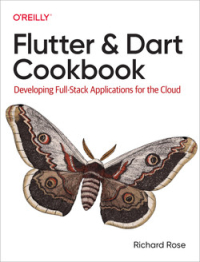
Flutter and Dart Cookbook
Learn the essentials of working with Flutter and Dart to build full stack applications that meet the needs of a cloud-driven world. Together, the Flutter open source UI software development kit and the Dart programming language for client development provide a unified solution to building applications capable of targeting multiple platforms. Recipes in this cookbook show you how this potent combination provides an efficient approach to application development. Typically used in frontend development, Flutter helps you develop cross-platform applications for Android, iOS, Linux, Mac, Windows, and the Google Fuchsia operating systems. The Dart SDK provides native access to third-party solutions, including APIs, databases, and authentication. When used in concert with Flutter, Dart allows you to compile source code ahead of time to native code. ...
Learn the essentials of working with Flutter and Dart to build full stack applications that meet the needs of a cloud-driven world. Together, the Flutter open source UI software development kit and the Dart programming language for client development provide a unified solution to building applications capable of targeting multiple platforms. Recipes in this cookbook show you how this potent combination provides an efficient approach to application development. Typically used in frontend development, Flutter helps you develop cross-platform applications for Android, iOS, Linux, Mac, Windows, and the Google Fuchsia operating systems. The Dart SDK provides native access to third-party solutions, including APIs, databases, and authentication. When used in concert with Flutter, Dart allows you to compile source code ahead of time to native code. ...
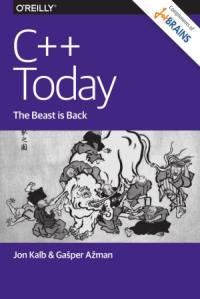
C++ Today
Now that software development is shifting primarily toward mobile and cloud computing, the venerable C++ programming language is returning to the dominant position it held during the object-oriented boom of the 1990s. In this O'Reilly report, you'll learn why C++ is once again the preferred choice across several diverse industries, after taking a backseat to Java during the 2000s. C++ is a complicated beast that's not easy to learn. But when you need a powerful, highly portable systems programming language or an application programming language with uncompromising performance, it's hard to beat. With the 2011 and 2014 updates, C++ feels like a completely new language, rather than the old C++ with new features bolted on. Authors Jon Kalb and Ga�per A�man demonstrate how modern C++ (C++11 and C++14) provides the power, performance, libraries, and tools necessary for massive server farms as well as low-footprint mobile apps. - Delve into the modern C++ features that are gener ...
Now that software development is shifting primarily toward mobile and cloud computing, the venerable C++ programming language is returning to the dominant position it held during the object-oriented boom of the 1990s. In this O'Reilly report, you'll learn why C++ is once again the preferred choice across several diverse industries, after taking a backseat to Java during the 2000s. C++ is a complicated beast that's not easy to learn. But when you need a powerful, highly portable systems programming language or an application programming language with uncompromising performance, it's hard to beat. With the 2011 and 2014 updates, C++ feels like a completely new language, rather than the old C++ with new features bolted on. Authors Jon Kalb and Ga�per A�man demonstrate how modern C++ (C++11 and C++14) provides the power, performance, libraries, and tools necessary for massive server farms as well as low-footprint mobile apps. - Delve into the modern C++ features that are gener ...
Pro DAX and Data Modeling in Power BI
Develop powerful data models that bind data from disparate sources into a coherent whole. Then extend your data models using DAX - the query language that underpins Power BI - to create reusable measures to deliver finely-crafted custom calculations in your dashboards. This book starts off teaching you how to define and enhance the core structures of your data model to make it a true semantic layer that transforms complex data into familiar business terms. You'll learn how to create calculated columns to solve basic analytical challenges. Then you'll move up to mastering DAX measures to finely slice and dice your data. The book also shows how to handle temporal analysis in Power BI using a Date dimension. You will see how DAX Time Intelligence functions can simplify your analysis of data over time. Finally, the book shows how to extend DAX to filter and calculate datasets and develop DAX table functions and variables to handle complex queries. ...
Develop powerful data models that bind data from disparate sources into a coherent whole. Then extend your data models using DAX - the query language that underpins Power BI - to create reusable measures to deliver finely-crafted custom calculations in your dashboards. This book starts off teaching you how to define and enhance the core structures of your data model to make it a true semantic layer that transforms complex data into familiar business terms. You'll learn how to create calculated columns to solve basic analytical challenges. Then you'll move up to mastering DAX measures to finely slice and dice your data. The book also shows how to handle temporal analysis in Power BI using a Date dimension. You will see how DAX Time Intelligence functions can simplify your analysis of data over time. Finally, the book shows how to extend DAX to filter and calculate datasets and develop DAX table functions and variables to handle complex queries. ...
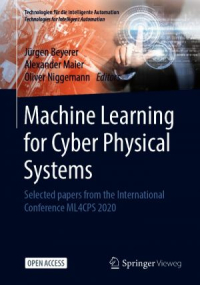
Machine Learning for Cyber Physical Systems
This open proceedings presents new approaches to Machine Learning for Cyber Physical Systems, experiences and visions. It contains selected papers from the fifth international Conference ML4CPS - Machine Learning for Cyber Physical Systems, which was held in Berlin, March 12-13, 2020. Cyber Physical Systems are characterized by their ability to adapt and to learn: They analyze their environment and, based on observations, they learn patterns, correlations and predictive models. Typical applications are condition monitoring, predictive maintenance, image processing and diagnosis. Machine Learning is the key technology for these developments.The EditorsProf. Dr.-Ing. Jurgen Beyerer is Professor at the Department for Interactive Real-Time Systems at the Karlsruhe Institute of Technology. In addition he manages the Fraunhofer Institute of Optronics, System Technologies and Image Exploitation IOSB.Dr. Alexander Maier is head of group Machine Learning at Fraunhofer IOSB-INA. His focus is on ...
This open proceedings presents new approaches to Machine Learning for Cyber Physical Systems, experiences and visions. It contains selected papers from the fifth international Conference ML4CPS - Machine Learning for Cyber Physical Systems, which was held in Berlin, March 12-13, 2020. Cyber Physical Systems are characterized by their ability to adapt and to learn: They analyze their environment and, based on observations, they learn patterns, correlations and predictive models. Typical applications are condition monitoring, predictive maintenance, image processing and diagnosis. Machine Learning is the key technology for these developments.The EditorsProf. Dr.-Ing. Jurgen Beyerer is Professor at the Department for Interactive Real-Time Systems at the Karlsruhe Institute of Technology. In addition he manages the Fraunhofer Institute of Optronics, System Technologies and Image Exploitation IOSB.Dr. Alexander Maier is head of group Machine Learning at Fraunhofer IOSB-INA. His focus is on ...